


How Do Rotary Retort Systems Sterilize Food Products? The Complete Science Behind Safer Canned Foods
Every time someone opens a can of soup, a bottle of baby food, or a pouch of ready-to-eat curry and finds it safe to eat after months on the shelf — a rotary retort system may well be responsible. Rotary retort sterilization is one of the most effective technologies in modern food manufacturing, yet most people — including many food industry professionals — are unclear on exactly how it works. This guide explains the full sterilization process in plain language: what happens inside a rotary retort, why rotation matters, how the machine achieves commercial sterility, and what kinds of food products benefit most.
Key Takeaways
A rotary retort system sterilizes food by combining pressurized heat with continuous container rotation, dramatically improving heat penetration into viscous products.
The rotation creates internal product movement (convective agitation), replacing the slow conduction-only heating seen in static retorts.
Typical operating temperatures range from 115°C to 135°C (239°F–275°F) at pressures of 1.5–3.0 bar.
Cycle times can be 30%–40% shorter than static retort processing for the same product and container size.
Rotary retorts are ideally suited for soups, sauces, beverages, dairy drinks, pet food, and ready-to-eat meals in cans or glass bottles.
All rotary retort processes must meet commercial sterility standards regulated by food safety authorities such as the U.S. FDA.
What Is a Rotary Retort System?
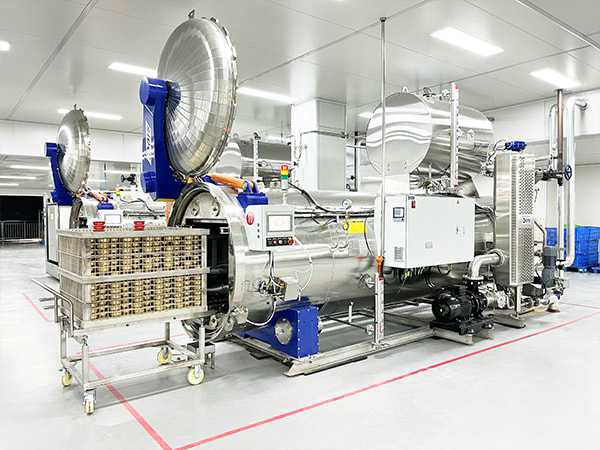
A rotary retort system — also called a rotary autoclave or rotary sterilizer — is a pressurized vessel used in commercial food processing to heat sealed containers of food to temperatures high enough to destroy all harmful microorganisms and bacterial spores. What distinguishes it from a conventional (static) retort is one crucial feature: the vessel or the basket inside it rotates continuously throughout the heating and cooling cycles.
In a standard still retort, containers of food simply sit in hot water or steam inside a sealed chamber. Heat must travel from the outside of the container inward, slowly working its way through the food. For products with a runny consistency — water, thin juice, broth — that process is relatively efficient. But for viscous products such as thick soups, creamed vegetables, tomato sauce, or pet food, heat moves through the product painfully slowly, creating a hot outer layer and a cool center. To bring the center to the required temperature, manufacturers must apply heat for a much longer time, which also means overcooking the outside layers.
The rotary retort solves this problem elegantly: as containers tumble and spin, the product inside moves with them. This internal churning acts like a stirring action — it continuously brings cooler product from the center into contact with the hot container wall, and pushes already-heated product toward the middle. Food scientists call this forced convective heat transfer, and it is far more efficient than passive conduction alone.
The Science of Food Sterilization: Why Heat and Pressure Are Both Needed
Before diving deeper into rotary systems, it helps to understand why food sterilization requires not just heat but also pressure. The primary target organism in low-acid canned food sterilization is Clostridium botulinum — a spore-forming bacterium whose toxin causes botulism, a potentially fatal illness. The spores of C. botulinum are extraordinarily heat-resistant and cannot be destroyed at normal boiling temperatures (100°C / 212°F) in any reasonable timeframe.
To reach temperatures above 100°C in a moist environment, water must be kept under elevated pressure — the same principle as a pressure cooker. A retort achieves this by sealing the vessel and introducing steam or hot water under controlled pressure, typically reaching 121°C (250°F) at approximately 1.05 bar (15 psi) above atmospheric. At this temperature, C. botulinum spores are destroyed within minutes.
The industry uses a concept called the F₀ value (thermal death time) to measure sterilization effectiveness. An F₀ of 3.0 is the widely accepted minimum for commercial sterility of low-acid foods — meaning the process delivers the equivalent lethal effect of 3 minutes at exactly 121°C. A well-designed rotary retort system achieves this F₀ value faster and more uniformly across every container in the batch, because rotation eliminates the temperature cold spots that can occur in still retorts.
| Concept | Meaning in Practice | Target Value (Low-Acid Foods) |
|---|---|---|
| F₀ Value | Equivalent lethality at 121°C (250°F) | ≥ 3.0 minutes |
| Processing Temperature | Core product temperature during hold phase | 115°C – 135°C |
| Overpressure | Pressure above steam saturation to protect container | 0.5 – 1.5 bar above steam pressure |
| Come-Up Time (CUT) | Time for retort to reach target temperature | Typically 5–20 minutes |
| Hold Time | Duration at target temperature | Product/container specific |
| Cooling Time | Controlled pressure cooling to below 40°C | Typically 15–40 minutes |
How a Rotary Retort System Actually Works: Step by Step
Understanding the process sequence is key to appreciating why rotary retort sterilization delivers such consistent results. Below is a breakdown of the full operating cycle.
The Role of Rotation: Why Speed Matters
Not all rotary retort systems rotate at the same speed, and getting this right is critical. Rotation speed is typically measured in revolutions per minute (RPM) and usually ranges from 4 to 30 RPM, depending on the product type and container size.
At low RPM, the product inside the container barely moves — providing only marginal improvement over a static retort. At very high RPM, the contents may separate due to centrifugal forces, which is also undesirable. The optimal rotation speed creates what engineers call a "tumbling headspace bubble": the small air gap (headspace) left inside the container moves back and forth as the container rotates, mechanically agitating the product and promoting internal convective mixing. This is particularly effective for liquid and semi-liquid foods.
In end-over-end rotation (axial rotation), the container rolls along its long axis, while in horizontal rotation, the reel spins containers around the vessel's central axis. Many modern rotary retort machines offer variable-speed drives, allowing operators to fine-tune rotation speed to match their specific product.
Heating Medium: Steam vs. Water Immersion
Rotary retort systems can use different heating media, and the choice affects efficiency, product compatibility, and running costs:
Steam: Direct steam injection is the simplest and most energy-efficient option for metal cans. Steam condenses on the container surface, releasing latent heat. Temperature uniformity across the vessel is excellent.
Pressurized Hot Water (Water Immersion): Containers are submerged in circulating hot water. This approach offers more precise overpressure control and is preferred for glass bottles and certain plastic containers that require external support to maintain their shape. DTS rotary water immersion retorts combine the agitation benefits of rotation with the gentle pressure management of a water bath.
Steam-Air Mixture: Used where very precise temperature uniformity is needed, such as for fragile or odd-shaped containers.
Rotary Retort vs. Static Retort: A Clear Comparison
Many food manufacturers face a direct choice between static (still) retorts and rotary retort systems. The following table summarizes the key differences to help clarify which technology suits which application.
| Feature | Static (Still) Retort | Rotary Retort System |
|---|---|---|
| Heat transfer mechanism | Conduction only | Conduction + forced convection (agitation) |
| Best for product viscosity | Low-viscosity or solid products | Medium to high-viscosity liquids and semi-liquids |
| Cycle time (typical soup) | Longer (baseline) | 30–40% shorter |
| Temperature uniformity | Good for water/thin liquids | Excellent for all liquid products |
| Product quality | Risk of overcooking outer layers | More uniform cooking; better texture/color retention |
| Compatible containers | Cans, pouches, trays, bottles | Primarily cans and glass bottles |
| Equipment complexity | Simpler | More complex (rotating seals, drive systems) |
| Energy consumption per batch | Higher (longer cycle) | Lower (shorter cycle, same output) |
| Ideal applications | Meats, vegetables, pouched products | Soups, sauces, beverages, baby food, pet food |
Which Food Products Benefit Most from Rotary Retort Sterilization?
The efficiency advantage of a rotary retort system is most pronounced when the product inside the container has a high enough viscosity to resist natural convection — i.e., when the contents do not freely circulate on their own when heated. Classic examples include:
Canned soups and stews — Chunky broths with vegetable or meat pieces benefit from rotation because the liquid carrier heats quickly and distributes heat to the solid pieces.
Sauces and gravies — Thick tomato sauce, pasta sauce, and meat-based gravies are among the product types that benefit most dramatically from rotary agitation.
Dairy-based beverages — Flavored milks, plant-based drinks, and fortified nutritional drinks in cans or glass bottles process more evenly with rotation.
Baby food — Purées and semi-solid baby foods in glass jars benefit from the gentler, more uniform heat distribution that rotation provides, helping preserve nutritional content.
Pet food — Wet pet food in cans is one of the largest commercial applications of rotary retort technology globally, as the viscous meat-based content is particularly well-suited to agitation sterilization.
Ready-to-eat meals and porridge — Cereal-based, rice, and mixed-ingredient RTE meals benefit from faster, more even sterilization that preserves texture better than prolonged static heating.
Canned beverages — Certain juice-based, sports, or nutritional drinks processed in small-format cans or bottles use rotary sterilizers for speed and throughput.
Key Components of a Rotary Retort Machine
A modern rotary retort machine is an engineered system with several interdependent components. Understanding these parts helps food manufacturers evaluate equipment specifications and maintenance requirements.
| Component | Function | Key Specification to Check |
|---|---|---|
| Pressure vessel (shell) | Contains the pressurized steam/water environment | Material (food-grade stainless steel), design pressure rating |
| Rotating reel / spiral track | Holds and rotates containers throughout the cycle | Container size range, RPM range, drive type |
| Rotary steam/water inlet (rotating joint) | Allows heating medium to flow into the rotating vessel | Seal type, leak-free operation at pressure |
| Drive motor & variable frequency drive (VFD) | Controls rotation speed precisely | Torque capacity, speed range, inverter control |
| Temperature & pressure sensors | Continuously monitor process parameters | Calibration accuracy (±0.5°C recommended) |
| PLC control system | Automates the full process cycle and records data | Data logging, alarm management, recipe storage |
| Safety valves & interlock systems | Prevent over-pressure and accidental opening under pressure | Compliance with pressure vessel safety standards |
| Heat exchanger / cooling water system | Enables controlled overpressure cooling | Cooling rate, water quality requirements |
Commercial Sterility and Regulatory Compliance
The goal of a rotary retort system is not absolute sterility — that would require conditions incompatible with food quality. Instead, the target is commercial sterility: the condition in which all pathogenic microorganisms and all other microorganisms capable of growing under normal non-refrigerated storage have been destroyed.
In the United States, manufacturers of commercially sterilized low-acid foods must comply with 21 CFR Part 113 (Code of Federal Regulations), which covers scheduled processes, retort operation, process deviations, and record-keeping. The European Union and most other major food safety authorities have equivalent regulations requiring documented process validation by an accredited processing authority before commercial production begins.
Key compliance requirements for rotary retort operation typically include:
Process schedule filed with a recognized processing authority, establishing minimum time-temperature parameters for each product/container combination.
Calibrated temperature-recording devices with a documented calibration schedule.
Trained operators who understand critical control points and process deviation procedures.
Full batch records for every sterilization cycle, retained for a specified period (typically 3 years in the U.S.).
Container integrity testing and post-process handling procedures to prevent recontamination.
Advantages and Limitations: What Buyers Should Know
Advantages of Rotary Retort Systems
Faster cycle times: Shorter sterilization times mean higher throughput, lower energy costs per unit, and reduced thermal damage to product quality.
Better product quality: More uniform heat delivery reduces overcooking on the container wall while ensuring the center reaches the required temperature. Colors, textures, and nutrients are better preserved.
Energy efficiency: Because each batch completes faster, steam consumption per unit of product is reduced compared to static processing of the same product.
Consistent F₀ delivery: Agitation improves temperature uniformity across all containers in a batch, reducing variation in the delivered F₀ value.
Versatility: Modern rotary retort machines can be configured for steam, hot water, or steam-air heating media, and can often handle multiple container sizes.
Limitations to Consider
Not ideal for fragile solid foods: Products like whole fish, delicate vegetable pieces, or fragile pasta may break apart under mechanical agitation. Static retorts are preferable for such products.
Limited pouch compatibility: Flexible retort pouches are generally not suitable because the constant rotation places stress on heat-sealed seams. Rigid or semi-rigid containers are standard for rotary retort processing.
Higher mechanical complexity: The rotating seals, drive systems, and variable-speed controls add maintenance requirements compared to simple static vessels.
Higher upfront cost: A rotary retort system typically carries a higher initial investment than a comparable static retort, though this is often offset by energy savings and improved capacity over the equipment's lifespan.
Looking for a Reliable Rotary Retort Machine Manufacturer?
DTS has supplied rotary retort systems and complete sterilization lines to food manufacturers in over 45 countries. Whether the project calls for a rotary water immersion retort for glass bottles, a steam rotary autoclave for canned soups, or a fully automated batch sterilization line, the DTS engineering team provides free process consultation, equipment specifications, and on-site installation support.
Request a Free Quote from DTS →How to Choose the Right Rotary Retort System for a Specific Application
Selecting the right rotary retort system requires matching equipment capabilities to the specific product, container, and production volume requirements. Below is a practical checklist of the key factors to evaluate.
| Factor | What to Assess |
|---|---|
| Product type and viscosity | Confirm the product will benefit from agitation (medium-to-high viscosity). Solid or fragile products may require a static retort instead. |
| Container type and size | Check that the retort reel accommodates the specific can or bottle dimensions. Most rotary retorts handle cans from 73mm to 153mm diameter. |
| Required process temperature | Confirm the vessel is rated for the target sterilization temperature, typically up to 135°C for high-acid-speed processes. |
| Batch volume and throughput | Calculate required containers per hour and select vessel diameter and basket count accordingly. |
| Heating medium | Steam is energy-efficient for metal cans; water immersion is gentler for glass and plastic. Clarify which medium suits the container material. |
| Automation level | Manual operation suits small-scale production; PLC-automated systems with data logging are essential for high-volume or export-market compliance. |
| Regulatory requirements | Confirm the manufacturer can provide validated process data and documentation compatible with target market regulations (FDA 21 CFR Part 113, EU, etc.). |
Summary: Why Rotary Retort Systems Matter
A rotary retort system sterilizes food by combining the proven power of high-temperature pressurized processing with the efficiency of continuous container rotation. The rotation creates forced convective heat transfer inside every container — dramatically accelerating sterilization of viscous products compared to static methods, reducing cycle times by 30–40%, and producing a more consistently safe, better-quality final product.
For food manufacturers producing soups, sauces, dairy beverages, baby food, pet food, or ready-to-eat meals at commercial scale, a rotary retort machine represents one of the most significant opportunities to improve both production efficiency and product quality simultaneously. The key is selecting a system from an experienced manufacturer who can validate the process schedule, support installation, and provide ongoing technical assistance.


