


PET Food Sterilization: Matching the Method to the Pack, the Product and the Shelf Life
A sealed pouch of wet pet food has to stay safe for a year or more on a warehouse shelf, and the method chosen for PET food sterilization decides whether that pack survives the process intact. The routes that work divide cleanly by pack format, product structure and the lethality target the process has to reach, and this guide sets out the numbers behind each choice.
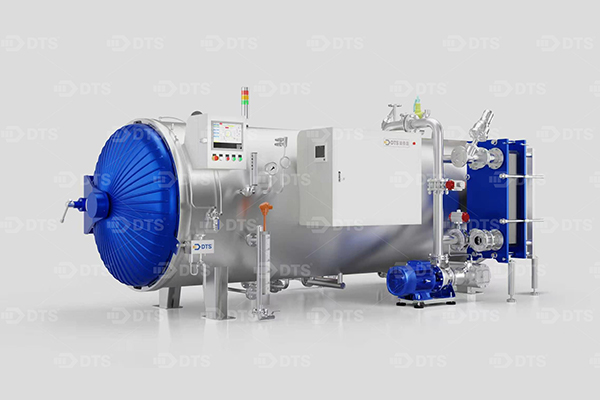
Key Takeaways
Sterilization applies to moist pet food in a hermetically sealed pack. Dry kibble is preserved by low moisture and low water activity, and does not pass through a retort.
For a low-acid product, meaning pH above 4.6 and water activity above 0.85, the reference target is an F0 of at least 3 minutes at 121.1 °C measured at the cold spot. Processes intended for long ambient storage are often designed for 6 minutes or more to cover heat-resistant thermophiles.
The heating medium follows the pack, not the brand: saturated steam suits rigid cans and jars, while steam-air mixtures, water immersion and water spray supply the overpressure that flexible pouches and trays need.
Agitation is the lever for dense products. A rotary retort tumbles the pack so a conduction-heating chunk heats faster, which shortens the cycle at the same lethality.
Every combination of product, pack and retort needs its own heat penetration study. A temperature setting carried over from another line is not a validated process.
Why PET Food Sterilization Differs From Ordinary Canning
Wet pet food reaches the market in several pack formats: drawn aluminum trays, retort pouches, tinplate cans, glass jars and sealed bowls. Each format behaves differently under pressure, and the product inside behaves differently under heat. A loaf-style pate heats almost entirely by conduction, a gravy with diced meat heats partly by convection until the starch thickens and the movement stops, and a high-fat emulsion can stratify as it warms. All of this happens inside a container that is already sealed, so the process cannot be adjusted once the cycle begins.
The second difference is regulatory. In the United States, thermally processed low-acid foods in hermetically sealed containers fall under the low-acid canned food requirements, which oblige a processor to establish a scheduled process, keep records and file process information for each product. Internationally, the Codex code of hygienic practice for low-acid canned foods sets out the same logic of a documented, validated process. In the European Union, feed hygiene rules and the animal by-product regulation govern the raw materials and the plant, while the thermal process itself has to be justified product by product. Pet food therefore sits at the intersection of food safety law and feed law, and the dossier has to satisfy both.
What Commercial Sterility Actually Means
Commercial sterility is not the absence of every microorganism. It means the pack contains no microorganism capable of growing in the product under normal ambient storage, and none of public health significance. A few heat-resistant spores may survive a legitimate PET food sterilization cycle; they cannot multiply in that product, so they cause no spoilage and no illness. This distinction matters because it explains why the target is a calculated lethality rather than a fixed number of minutes on a dial.
That lethality is expressed as F0: the equivalent minutes at 121.1 °C that a process delivers, integrated across the whole come-up, hold and cooling phase at the cold spot. Two microbial values sit underneath it. The D value is the time at a given temperature to destroy 90 percent of a population, and for Clostridium botulinum spores it is roughly 0.21 minutes at 121.1 °C. The z value is the temperature change that shifts the D value tenfold, about 10 °C for the same organism. Twelve decimal reductions, the classic botulinum cook, therefore require about 2.52 minutes, and regulators rounded that up to a 3 minute minimum for low-acid foods. Shelf-stable products intended for warm climates are usually designed well above the minimum, because Geobacillus stearothermophilus and related thermophiles are far more heat resistant than the pathogen and will spoil a pack that only just meets the safety floor.
Where the Cold Spot Sits, and Why It Moves
Two different cold spots have to be controlled. The retort cold spot is the position inside the vessel that receives the least heat, and it depends on how steam or water reaches every corner of the load. Trapped air in a steam retort, a blocked nozzle in a spray system or an unevenly stacked basket will each create one. The container cold spot is the slowest-heating point inside a single pack. In a thin liquid it sits low in the container because convection currents carry heat upward; in a thick paste it sits at the geometric center because heat arrives only by conduction.
Pet food often shows broken heating. A starch-thickened gravy starts as a convecting liquid, then gels as the temperature rises, and the heat transfer mechanism switches from convection to conduction partway through the cycle. A heat penetration study captures that curve; a calculation based on the initial behaviour alone will overestimate how fast the center heats. Cook value, the companion metric to F0, tracks the quality side of the same curve, since the surface of a pack can receive several times the thermal exposure of its center.
The Retort-Based PET Food Sterilization Methods
Five retort configurations cover most wet pet food production. All of them heat a sealed pack above 100 °C in a pressure vessel, and all of them rely on the same physics of heat transfer to a cold spot. What separates them is the heating medium, the way overpressure is generated, and whether the pack is agitated during the cycle.
Saturated Steam Retort
A saturated steam retort fills the vessel with steam at the process temperature and relies on the latent heat released as it condenses on the pack. The heat transfer coefficient is the highest of any medium, which makes the cycle short and the equipment simple. The condition is complete air removal: any air left in the vessel forms a pocket with a lower temperature, and the packs in that pocket are under-processed while the instrument in the drain line reads the correct value. Venting and air-detection are therefore part of the process, not housekeeping. Because the internal pressure of a sealed pack rises with temperature and the vessel offers no counter-pressure, saturated steam suits rigid containers such as tinplate cans and glass jars, and it is unsuitable for flexible pouches that would balloon and split a seal.
Steam-Air Mixture Retort
A steam-air retort adds compressed air to the steam so that the total vessel pressure exceeds the saturated steam pressure at the process temperature. That excess is the overpressure, and it is what holds a flexible pack in shape while its contents expand. Because the air fraction can be adjusted independently of temperature, the same vessel can run a pouch cycle at 121 °C with 1.8 bar of overpressure and a can cycle with almost none. The trade-off is that a steam-air mixture must be kept homogeneous by forced circulation; without a fan or an effective mixing pattern, the air stratifies, and the top of the load runs cooler than the bottom. Steam-air is the standard choice for retort pouches, aluminum trays and sealed bowls.
Water Immersion Retort
In a water immersion retort the load is submerged in a body of hot water, with compressed air providing overpressure. Heat reaches the pack by convection from the water, and because water carries a large thermal mass, the vessel is forgiving of uneven loading. It handles cans, jars and heavy trays well and is often chosen where load density is high and the pack is rigid or semi-rigid. The cost is thermal inertia: heating several cubic meters of water takes longer than filling a vessel with steam, so come-up is slower and the total cycle longer. Water chemistry matters as well, since scale and chloride both attack the outside of cans and the vessel itself.
Water Spray Retort
A water spray retort recirculates process water through nozzles that distribute it over the load, heating the packs through a thin, continuously renewed film rather than by immersion. Overpressure comes from compressed air in the same way, so pouches, trays and bowls are all within scope, and cans can be run in the same vessel. Compared with immersion, a spray system uses far less water, heats and cools faster, and recovers energy from the cooling circuit more easily, which is why this configuration carries the largest share of PET food sterilization duty in pouch and tray plants. Uniformity depends on the spray pattern and the loading arrangement: a blocked nozzle, an over-tight basket or a pack that shields its neighbour creates a cold zone that the return-water temperature sensor will not reveal. A water spray retort is therefore specified together with a loading diagram, and the heat penetration study is run in the worst position of that diagram.
Rotary and Agitating Retort
A rotary retort turns the basket end over end during the hold, so the product inside each pack is continually rearranged against the package wall. For a conduction-heating product such as a dense meat loaf or a chunky stew in thick gravy, agitation can cut process time substantially at the same F0, and the shorter exposure protects color, texture and volatile flavor compounds. The pack has to tolerate the motion: cans and rigid trays are straightforward, while thin pouches need a carrier or a clamped arrangement to avoid abrasion and seal stress. A rotary retort is the usual answer when a formula is too dense for a static cycle to reach the cold spot in a commercially sensible time.
Choosing a Retort for a Specific Pack Format
Pack format, fill weight and target F0 determine which vessel and which loading pattern apply. Published pack pages and process data shorten that comparison.
Non-Retort Routes and Where They Stop Short
Retorting is the reference route for PET food sterilization, but the alternatives occupy narrower ground. Each removes or inactivates microorganisms by a different mechanism, and each has a limit that decides whether the finished pack can stand on a shelf at ambient temperature.
High Pressure Processing
High pressure processing subjects a sealed, flexible pack to 400 to 600 MPa for a few minutes at chilled or ambient temperature. Vegetative pathogens, yeasts, moulds and parasites are inactivated, and the sensory profile stays close to fresh, which is why the technology has a following in raw and fresh-chilled pet food. The limit is spores. Bacterial spores survive the maximum industrial pressure, so an HPP pack of a low-acid product has to be distributed and stored chilled to stop them germinating. Rigid containers such as glass jars and tinplate cans cannot be used, because the pressure has to be transmitted through a flexible interface. HPP is a pasteurization step, not a sterilization step, and treating it as the latter is a documented route to a spoiled or unsafe batch.
Aseptic Processing and UHT
Ultra-high temperature treatment holds a liquid at roughly 135 to 150 °C for a few seconds, then cools it and fills it into a pre-sterilized package in a sterile environment. Lethality is high and the thermal exposure is short, so quality retention is good. The constraint is physical: the product must be pumpable and homogeneous enough to pass through a heat exchanger and a filling valve, which rules out visible chunks of meat or vegetable. Gravies, broths, milk-replacer drinks and fine purees fit; a chunk-in-gravy recipe does not.
Microwave-Assisted and Ohmic Heating
Microwave-assisted thermal sterilization heats a packaged product with 915 MHz energy plus a pressurised hot-water bath to hold the pack in shape, and it has received regulatory acceptance for specified low-acid products. Ohmic heating passes an electric current through the food itself, which heats particulates and liquid at a similar rate and avoids the slow conduction path that limits conventional retorting. Both approaches shorten the gap between surface and center exposure, and both remain limited by the validation burden: every product and pack geometry needs its own process, and the installed industrial base is small compared with retorting.
What Dry Pet Food Actually Relies On
Dry kibble is not sterilized, and it does not need to be. Extrusion cooks the dough under pressure and heat, the die forms the kibble, and drying brings the product to a moisture content of roughly 10 percent, with a water activity well below the 0.85 threshold that would allow bacterial growth. Shelf stability comes from that low water activity, not from lethality. The microbiological risk profile is different as well: the concern in dry pet food is contamination after the kill step, particularly with Salmonella from the environment, ingredients or post-extrusion handling, which is why hygiene controls and finished-product testing carry more weight than retort validation, a pattern that the safety information published for pet food reflects in its recall record.
Matching the Method to the Pack and the Product
Package Compatibility Sets the Shortlist
The pack decides the pressure regime that any PET food sterilization method has to respect, before any other consideration. A tinplate can or a glass jar has enough rigidity to resist its own internal pressure, so a saturated steam cycle is available and the vessel needs no air supply. A retort pouch, an aluminum tray or a sealed bowl will deform as internal pressure rises, so the vessel has to supply an external pressure that tracks the internal one. That tracking is the single most important control on a flexible-pack line: too little overpressure and the seal fails or the pouch balloons, too much and the pack is crushed on cooling. Equipment built for pouches typically holds the differential within a few hundredths of a bar across the cycle, and the control loop has to follow the cooling phase as well, because the pressure inside a pack falls faster than the vessel pressure when the spray or water stops.
Product Structure Decides the Cycle Length
Fill weight, chunk size, viscosity and fat content all change the shape of the heat penetration curve. A 70 g pouch of pate reaches its cold spot in a fraction of the time needed by a 400 g tray of the same recipe, and a gravy that gels on heating behaves like a solid from the moment the starch sets. Three practical consequences follow. First, cycle design is done per product and per pack, not per machine. Second, a change in fill weight or chunk size is a change to the scheduled process and triggers revalidation. Third, the lever for dense products is either agitation or a thinner pack, since raising the temperature shortens the hold but damages the surface layer disproportionately.
Throughput Decides the Line Architecture
A single batch retort suits a plant with a wide recipe range and modest volume. As volume grows, the constraint moves from the vessel to the loading and unloading of it: baskets, tray handlers and shuttle systems determine how many cycles a day the plant can actually run. Automated batch retort systems link several vessels to one loading robot and one recipe server, which keeps the process record consistent across vessels and allows a pack format change without re-entering the cycle parameters by hand. Utilities follow the same logic. Steam, compressed air and cooling water are sized on the peak simultaneous demand of the vessels, not on the average, and heat recovery from the cooling circuit is worth designing in at the start rather than retrofitting later.
Equipment for this stage of the decision is usually compared on pack format and process data rather than on vessel size alone, which is why the three configurations below are the ones most often specified side by side for wet pet food.

Steam Water Spray Retort
Spray and steam heating with air overpressure for pouches, trays, bowls and cans in one vessel.
View Product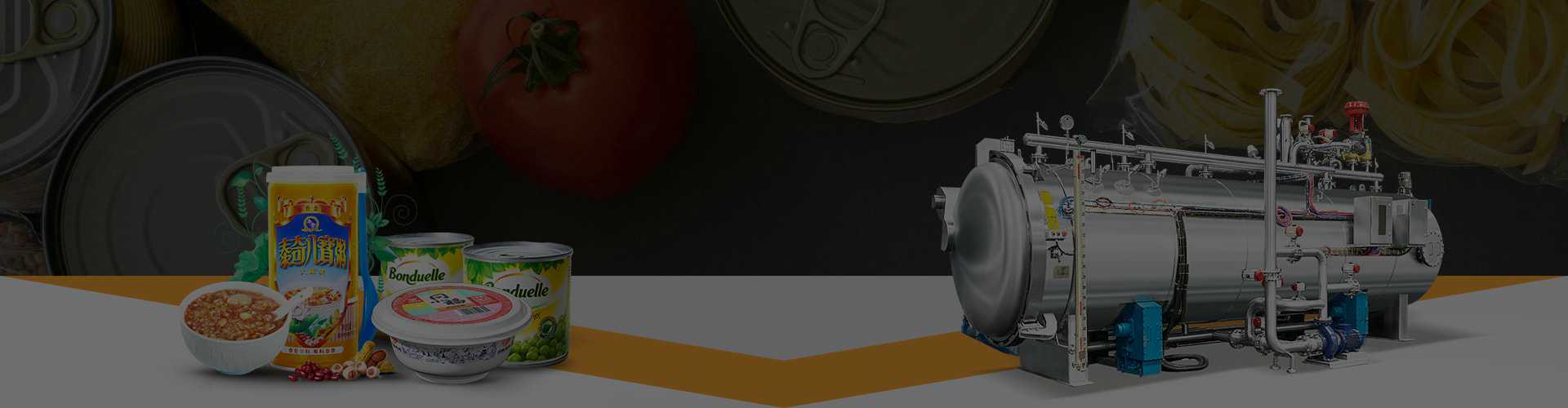
Rotary Retort
End-over-end agitation for dense, conduction-heating products where a static cycle would run too long.
View Product
Steam-Air Retort
Steam and air mixture with adjustable overpressure for flexible packs that must hold their shape.
View ProductWhat a Validation File for PET Food Sterilization Should Contain
Validation is where a method becomes a process, and for PET food sterilization the deliverable is a scheduled process: a documented combination of temperature, pressure, time and loading pattern that delivers the required F0 to the cold spot of the worst pack in the worst position of the vessel. The evidence behind it comes from a heat penetration study, in which thermocouples are placed at the cold spot of several packs distributed through the load, and the resulting curves are integrated to give F0 and cook value. The study is run on the largest fill weight, the densest product and the coldest location, because those are the conditions that limit lethality.
Three supporting elements are easy to overlook. The come-up phase contributes lethality that a conservative calculation ignores, so the record has to state whether it was counted. The pressure record has to be kept alongside the temperature record for flexible packs, since a seal failure is a pressure event, not a thermal one. And the deviation procedure has to be written before the first deviation occurs: a pack that did not receive its scheduled process cannot be released on the assumption that it was close enough. The relationship between D value, z value and F0 is worth working through with the plant's own product data, because it explains why a small temperature shortfall costs far more hold time than the number suggests.
PET Food Sterilization Methods Compared
The table below sets the retort routes against the two non-thermal alternatives on the criteria that decide a PET food sterilization specification: the heating medium and how overpressure is generated, the pack formats that fit, the process window, and the failure mode to watch.
| Method for PET food sterilization | Medium and overpressure | Pack formats | Typical process window | Main watch point |
|---|---|---|---|---|
| Saturated steam retort | Steam only, no overpressure | Tinplate cans, glass jars | 110 to 130 °C, F0 target 3 to 12 minutes | Residual air creating a cold pocket |
| Steam-air mixture retort | Steam plus compressed air, adjustable overpressure | Retort pouches, trays, bowls | 115 to 130 °C with 1 to 2.5 bar overpressure | Air stratification without forced circulation |
| Water immersion retort | Hot water with air overpressure | Cans, jars, heavy rigid trays | 110 to 130 °C, longer come-up | Water chemistry, scale, thermal inertia |
| Water spray retort | Recirculated spray with air overpressure | Pouches, trays, bowls, cans | 115 to 130 °C, faster heating and cooling | Nozzle and loading uniformity |
| Rotary or agitating retort | Steam or water with rotation of the basket | Cans, rigid trays, supported pouches | 115 to 130 °C, cycle shortened by agitation | Pack abrasion and seal stress |
| High pressure processing | 400 to 600 MPa in a chilled or ambient vessel | Flexible pouches and vacuum packs only | 2 to 6 minutes hold, chilled distribution | Spores survive; not a sterilization step |
| Aseptic processing and UHT | 135 to 150 °C for seconds, sterile filling | Liquids and fine purees in aseptic packs | Seconds rather than minutes | Chunks and high viscosity cannot pass |
Validating a New Wet Pet Food Recipe or Pack?
A process review starts from the product, the pack and the target shelf life, and returns a cycle proposal with the parameters that need testing.
Conclusion
The choice of PET food sterilization method for wet pet food follows from three facts about the product rather than from a preference for one machine. The pack determines whether overpressure is needed, the product structure determines how fast the cold spot heats, and the water activity and pH determine the lethality the process must deliver. Once those are fixed, the shortlist is short: steam for rigid cans and jars, steam-air or water spray for flexible packs, agitation where the formula is too dense for a static cycle, and a non-thermal route only where the chilled chain is part of the product concept.
For readers comparing PET food sterilization equipment manufacturers, DTS publishes pack-format pages, retort specifications and a direct technical inquiry channel for evaluation against a specific product and pack.
FAQ
Which sterilization method suits retort pouches of wet pet food?
A pouch needs a vessel that supplies overpressure, which narrows the choice of PET food sterilization method to a steam-air mixture retort or a water spray retort with compressed air. Both hold the external pressure above the internal pressure of the pack through heating and cooling, which keeps the seal intact. A saturated steam retort without overpressure does not suit flexible packs.
Is an F0 of 3 minutes enough for PET food sterilization?
Three minutes at 121.1 °C is the minimum commonly applied to low-acid foods, and it corresponds to a twelve decimal reduction of Clostridium botulinum spores. It is a safety floor rather than a shelf-life target. Products stored in warm conditions are usually designed for 6 minutes or more, because heat-resistant thermophiles survive a process that only meets the minimum.
Can high pressure processing replace retort sterilization for pet food?
Not for shelf-stable packs. Bacterial spores survive the maximum industrial pressure of about 600 MPa, so an HPP pack of a low-acid product must be stored and distributed chilled. HPP pasteurizes rather than sterilizes, and it also cannot be used with glass jars or tinplate cans because the pressure has to reach the food through a flexible pack wall.
Why do pouches burst inside a retort?
The internal pressure of a sealed pack rises with temperature, and if the vessel pressure does not track it closely the differential loads the seal until it fails. The usual causes are insufficient overpressure during come-up, pressure released too early in cooling, or a headspace and seal strength that were not matched to the cycle. Loading that stacks packs tightly can also trap air and create local hot or cold zones.
Does dry pet food need sterilization?
No. Extrusion cooking plus drying brings kibble to a moisture content of roughly 10 percent and a water activity well below 0.85, which prevents bacterial growth without a retort step. The microbiological control in dry pet food focuses on preventing contamination after the kill step, particularly with Salmonella, rather than on achieving commercial sterility.
References and Notes
Thermally processed low-acid foods packaged in hermetically sealed containers — scheduled process, records and process filing duties (ecfr.gov, accessed 2026-11-13)
Codex Alimentarius standards and codes of practice — international basis for hygienic practice in low-acid canned foods (fao.org, accessed 2026-11-13)
Pet food information published by the US Food and Drug Administration — product categories, safety expectations and recall context (fda.gov, accessed 2026-11-13)
Data notes: the F0 reference of 121.1 °C, the z value of 10 °C, the D value of about 0.21 minutes for Clostridium botulinum at 121.1 °C, the 2.52 minute twelve decimal reduction and the 3 minute regulatory minimum are standard thermal processing values, not equipment specifications. Process windows in the table are ranges typical of commercial practice across pack formats and are not a fixed value for any single product; the actual cycle must come from a heat penetration study. Overpressure values quoted for flexible packs describe vessel capability, not a recommendation for a specific pouch.
Terminology note: in this article PET refers to pet animal food, not to polyethylene terephthalate packaging.


