


D-Value, z-Value and F₀ Value in Food Sterilization | Retort Processing Guide
Reaching a set temperature does not automatically mean that a product has received the required level of microbial control. In food thermal processing, different microorganisms respond differently to heat, and processing effectiveness can change significantly with temperature. A pouch of sauce, a can of vegetables and a tray of ready meal can sit in the same vessel at the same setpoint and still require different processing times. D-values, z-values and F₀ values are commonly used to describe microbial heat resistance, the effect of temperature on that resistance and the cumulative thermal lethality delivered during a process. Understanding how these parameters relate can help food manufacturers develop and evaluate thermal processing procedures for canned foods, ready meals, sauces and other packaged products. This guide explains what each number means in retort processing, how the three connect, and why the temperature at the slowest-heating point inside a container matters more than the number on the control panel in food sterilization.
Key Takeaways
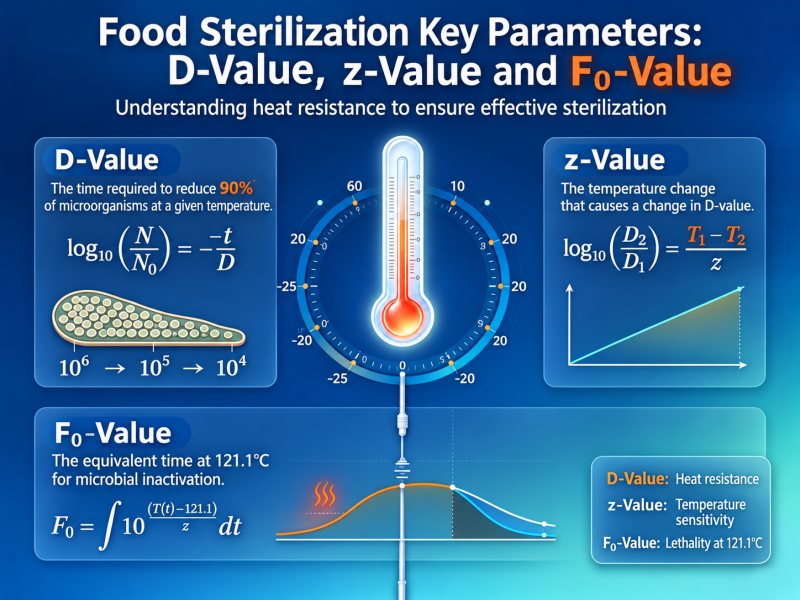
D-value states how long a given temperature takes to reduce a microbial population by 90%; z-value states how that time changes when temperature changes.
F₀ converts an entire temperature history into equivalent minutes at 121.1°C, so heating and cooling both contribute to the retort processing result.
Food sterilization aims at commercial sterility rather than literal sterility, and low-acid sealed products carry the most demanding thermal requirements.
A change in formulation, viscosity, particle size or container geometry can make existing heat penetration data unrepresentative of the new product.
Why Three Numbers Define Food Sterilization in Retort Processing
Food sterilization is not simply a matter of heating a product for a set period of time. The process must deliver an appropriate level of thermal treatment at the relevant location within the product, and that location is usually the point inside the container that heats most slowly. Two products may be processed at the same retort temperature but require different processing conditions, because the heat resistance of the target microorganism, product formulation, acidity, package size and heat transfer characteristics can all affect the process. Different microorganisms also respond differently to heat, which is why processing effectiveness changes significantly with temperature.
In practical terms, thermal process development often needs to answer three questions: how heat-resistant is the target microorganism, how does a change in temperature affect its heat resistance, and how much cumulative thermal lethality does the product receive during processing? D-value, z-value and F₀ provide a framework for addressing these questions when applying heat in retort processing, and the three are closely connected.
For shelf-stable, hermetically sealed foods the end point is commercial sterility, a regulatory condition rather than an absolute one. Under 21 CFR 113.3, commercial sterility means the food is free of microorganisms capable of reproducing under normal non-refrigerated storage and distribution, and free of viable microorganisms of public health significance. The same regulation defines low-acid foods as those with a finished equilibrium pH greater than 4.6 and a water activity greater than 0.85, and requires a scheduled process to be at least equivalent to one established by a competent processing authority. Current United States regulations for thermally processed low-acid foods set out these definitions.
What commercial sterility means for food sterilization
Commercial sterility describes a condition, not a claim that no organisms remain: surviving microorganisms cannot grow during normal ambient storage, and organisms of public health significance, including spores, have been destroyed. The scheduled process that achieves it is product-specific. In a food sterilization programme, this is a practical part of process development rather than a theoretical endpoint, and it applies particularly to low-acid products in hermetically sealed containers.
D-Value: The Time Behind a One-Log Reduction
The D-value, or decimal reduction time, is the time required at a specified temperature to reduce a microbial population by one logarithmic cycle, equivalent to a 90% reduction. For example, if the D-value of a microorganism at 121.1°C is one minute, then under ideal log-linear inactivation an initial population of 1,000,000 falls to 100,000 after one minute, 10,000 after two minutes and 1,000 after three minutes. The relationship is generally expressed as log₁₀(N/N₀) = −t/D.
In that equation, N₀ is the initial microbial population, N is the surviving microbial population after heating, t is heating time and D is the D-value at the specified temperature. If the initial population, target reduction and D-value are known, the theoretical processing time can be estimated as t = D × log₁₀(N₀/N).
A D-value is not a universal number that can be applied to every product. The same microorganism may show different heat resistance depending on the food matrix, processing temperature and test conditions. Published regulatory guidance notes that the value depends on the spore species and the food in which the spores are suspended; pH, fat content, water activity and the test method also matter. United States inspection guidance on thermal processing symbols illustrates this with a D₂₄₀ value of one minute. For this reason, data from one product should not automatically be applied to another formulation.
For low-acid canned foods, a widely taught benchmark is a 12D reduction of Clostridium botulinum spores: twelve logarithmic reductions of the organism associated with botulism prevention. Using the textbook value of D₁₂₁ = 0.21 min, that corresponds to about 2.52 minutes at 121.1°C. This is a public-health design reference taught in food science, not a scheduled process for a specific product; spoilage organisms and quality targets frequently call for longer cycles.
From a D-value to a required holding time
Once the initial population, the target reduction and the measured D-value are known, the theoretical holding time follows from t = D × log₁₀(N₀/N). The calculation assumes log-linear survival and a constant product temperature, so it is a starting point for retort processing design rather than a validated process time.
z-Value: How Temperature Reshapes Microbial Heat Resistance
The z-value is the temperature change needed to shift the D-value by a factor of ten. It is expressed in °C (or °F) and is written as log₁₀(D₂/D₁) = (T₁ − T₂)/z, where D₁ and D₂ are D-values measured at temperatures T₁ and T₂.
With z = 10°C, a 10°C rise theoretically reduces the D-value to one tenth of its previous value under the assumed model. This explains why relatively small changes in processing temperature can have a significant effect on thermal lethality. Regulatory inspection guidance describes the same slope as 18°F and gives a typical range of 16–20°F for spore death time, while 10°C (18°F) is the conventional reference used with F₀.
Higher temperatures can also increase thermal effects on product quality, including texture, color and flavor, and may stress packaging. Process development therefore involves balancing microbial control with measurable quality attributes when selecting a temperature-time combination for food sterilization.
F₀ Value: Cumulative Lethality Across Heating, Holding and Cooling in Retort Processing
During a retort process, thermal lethality is not limited to the holding stage. The product begins to accumulate lethal effect as it heats, continues during the holding period, and may receive additional lethality during the early stages of cooling. F₀ is generally used to quantify this cumulative thermal lethality, expressed as equivalent minutes at a reference temperature of 121.1°C (250°F), often with a z-value of 10°C.
The basic equation treats temperature as a continuous function of time: F₀ = ∫ 10^((T(t) − 121.1)/z) dt, where T(t) represents the temperature history at the relevant product location over time. When z = 10°C, the equation becomes F₀ = ∫ 10^((T(t) − 121.1)/10) dt.
In practical data analysis, F₀ can be calculated from recorded temperature measurements using a step-by-step approximation: F₀ ≈ Σ Lᵢ × Δt, with Lᵢ = 10^((Tᵢ − 121.1)/z) as the lethality rate and Δt as the time interval between measurements. The corresponding temperatures are taken at the same product location. At 121.1°C the theoretical lethality rate is 1; it increases above the reference temperature and decreases at lower temperatures. Background reference material on thermal death time sets out the same 250°F reference and the 10°C slope.
Because a recorded cycle includes come-up and cooling time, elapsed retort processing time commonly exceeds the calculated F₀ value: heat has to reach the slowest-heating point inside the product first.
Where the Thermocouple Goes: Cold Spots, Heat Penetration and a Validated Retort Processing Schedule
One common mistake in food sterilization is to focus only on the temperature displayed by the retort control system. The retort temperature does not necessarily represent the temperature at every point inside the package, because the setpoint describes the heating medium rather than the product. For thermal process evaluation, the temperature history at the cold spot is often critical, since that location inside the product heats most slowly.
Product viscosity, particle size, package dimensions, initial product temperature and heat transfer characteristics can all affect how quickly the cold spot heats up, depending on the package system in use. If a low-viscosity liquid product is reformulated into a thicker sauce, or if the package size changes, the existing heat penetration data may no longer represent the new product conditions. These changes should be evaluated before applying an existing thermal process to a new batch of product, which is an important part of measuring and validating food sterilization work in retort processing.
Equipment configuration is part of that picture: a water spray retort, a rotary retort, other units in a sterilization retort series and automated loading and unloading equipment all influence how heat reaches containers of different sizes, including pouches, cans, glass bottles, trays and jars. Heat penetration trials are therefore run on the actual production unit, particularly for ready meals, porridge and pet food in flexible packs.
Two commonly compared retort sterilizer configurations are shown below with their published product pages.

Steam Water Spray Retort Machine
Water spray retort equipped with a control system that manages the full process cycle for packaged foods.
View Product
Rotary Retort Machine
Rotary retort used for viscous products such as soups and sauces, where container movement supports heat transfer.
View ProductMatch Equipment Specifications to the Process
Specification sheets, engineering documentation and a direct inquiry channel are available for readers assessing a defined product and container type.
From Calculation to a Validated Scheduled Process in Food Sterilization
D-value, z-value and F₀ provide useful tools for understanding and evaluating food thermal processing, but mathematical calculations alone do not replace process development and validation. A practical sterilization process also needs to consider the target microorganism, food formulation, pH, package system, heat penetration characteristics and applicable regulatory requirements.
For shelf-stable, hermetically sealed foods, particularly low-acid products, processing parameters should be established and validated according to the specific product and applicable requirements. The organism of public health concern is Clostridium botulinum; the United States handbook of foodborne pathogenic microorganisms summarises its characteristics. Processing procedures designed for one product typically cover heat penetration studies, temperature distribution checks, defined critical factors and documented records.
Product pH is one of those critical factors: how food pH affects microbial growth and retort sterilization requirements explains why acidified products follow a different thermal route.
Results from retort processing calculations are therefore inputs to a validation package, not substitutes for one.
Reference Values and a Worked Lethality Table for Retort Processing
The following reference values summarise the main purpose of each parameter in food sterilization and show how lethality rates scale with temperature in an F₀ value calculation for retort processing. Rates below are calculated from L = 10^((T − 121.1)/10) for z = 10°C; they are mathematical results rather than measured product data.
| Parameter in food sterilization | Definition and unit | Role in retort processing |
|---|---|---|
| D-value | Minutes at a stated temperature for a 90% (1 log) reduction | Defines the heat resistance of the target organism in a given food |
| z-value | °C (or °F) needed to change the D-value tenfold; 10°C (18°F) is the conventional reference | Converts lethal effect between different product temperatures |
| F₀ value | Equivalent minutes at 121.1°C with z = 10°C | Sums cumulative lethality across heating, holding and cooling |
| 12D benchmark | About 2.52 min at 121.1°C for D₁₂₁ = 0.21 min (textbook value) | A public-health design reference for low-acid canned foods, not a scheduled process |
| Product temperature (°C) | Lethality rate L in retort processing | Equivalent minutes at 121.1°C per minute |
|---|---|---|
| 111.1 | 0.10 | 0.10 |
| 116.1 | 0.32 | 0.32 |
| 121.1 | 1.00 | 1.00 |
| 126.1 | 3.16 | 3.16 |
| 131.1 | 10.00 | 10.00 |
The table shows why cycles in retort processing cannot be judged from time alone: under the stated model, one minute at 131.1°C contributes the same calculated lethality as ten minutes at 121.1°C in food sterilization. This is a useful illustration, but a limited one, because real heating and cooling stages vary with the product.
Continue With Product and Process Documentation
Product listings, reference articles and an inquiry form are available for readers comparing equipment configurations.
Conclusion
D-values, z-values and F₀ help turn the question of how long a product should be heated into a more structured assessment of microbial heat resistance and thermal lethality. The D-value describes resistance at a given temperature, the z-value shows how that resistance changes with temperature, and the F₀ value measures the cumulative thermal lethality delivered during the process. Used alongside heat penetration studies and process validation in retort processing, these parameters provide an important technical foundation for developing food sterilization procedures for shelf-stable packaged foods.
For readers comparing food sterilization and retort processing equipment manufacturers, DTS provides published specifications, technical documentation and direct inquiry channels for further evaluation.
FAQ
A D-value is the time at a stated temperature needed to reduce a microbial population by 90% (one log). In retort processing it describes the heat resistance of the target organism under defined test conditions, and it changes with temperature, food composition and pH.
121.1°C equals 250°F, the historical reference used to express F₀ as equivalent minutes. Combined with a z-value of 10°C, it lets lethality recorded at different temperatures be converted to a common scale.
Not without re-evaluation. Viscosity, particle size, fill weight, container dimensions and initial temperature alter heat penetration at the cold spot, so the recorded temperature history and the resulting F₀ value may differ from the original study.
The cold spot is the slowest-heating location inside a container. Lethality calculations use its temperature history rather than the vessel setpoint, because microbial reduction depends on the temperature actually reached within the product.
No. F₀ is a calculated measure of thermal lethality. A scheduled process for shelf-stable, hermetically sealed low-acid foods also requires heat penetration data, defined critical factors, competent process-authority review and documented records.
References and Notes
United States regulation on thermally processed low-acid foods — 21 CFR Part 113.3 definitions of commercial sterility, low-acid foods (pH greater than 4.6, water activity greater than 0.85) and scheduled processes (accessed 2026-11-06).
United States inspection guidance on thermal processing symbols — D-value, z-value and F-value definitions, the 12D benchmark, and a z slope of 18°F within a typical 16–20°F range for spore death time (accessed 2026-11-06).
United States handbook of foodborne pathogenic microorganisms — background on Clostridium botulinum as the organism of public health concern in low-acid canned foods (accessed 2026-11-06).
Background reference material on thermal death time — 250°F (121.1°C) reference, z = 10°C, D₁₂₁ = 0.21 min and the 2.52 min 12D example (accessed 2026-11-06).
Data notes: 121.1°C and z = 10°C are conventional reference conditions for food sterilization and retort processing; 0.21 min and 2.52 min are textbook teaching values for C. botulinum spores, not product-specific process parameters. Lethality rates in the second table are calculated from L = 10^((T − 121.1)/10). Product card descriptions are taken from the linked product pages and represent manufacturer-stated information rather than industry-wide values.


