


Psychrophilic, Mesophilic and Thermophilic Bacteria: How Does Temperature Affect Microbial Growth?
Every microorganism grows within a defined band between a minimum and a maximum, and microbial growth temperature decides which spoilage organisms and pathogens a process has to defeat. The three familiar labels are shorthand for those bands, and the differences between them explain why chilled food, ambient canned food and tropical warehouse storage need three different control strategies.

Key Takeaways
Each species has three cardinal temperatures: a minimum, an optimum and a maximum. The psychrophile, mesophile and thermophile labels describe where those cardinal points fall, not a switch that turns growth on and off.
Cold-tolerant psychrotrophs such as Listeria monocytogenes grow at refrigeration temperature, so a chilled chain slows spoilage without sterilizing the product.
Most foodborne pathogens are mesophiles with an optimum near 30 to 37 °C, including Clostridium botulinum, whose spores define the 12 decimal reduction target behind a 3 minute F0 process.
Thermophilic spores are far more heat resistant than the pathogens: Geobacillus stearothermophilus has a D121 of roughly 1.5 to 4 minutes against 0.21 minutes for C. botulinum, which is why commercial sterility is supported by storage temperature rather than by heat alone.
Microbial growth temperature is only one axis. Water activity, pH, available nutrients and the package all shift the effective range, which is why a schedule is validated per product rather than per organism.
What Microbial Growth Temperature Actually Describes
Temperature affects a bacterial cell through its enzymes and membranes. Below the minimum, molecular motion and enzyme activity slow to the point where metabolism stops; above the maximum, proteins denature irreversibly and the membrane loses its selective function. Between those limits, growth rate rises to a peak at the optimum and then falls away sharply. The three points together are called the cardinal temperatures, and they are a property of the strain, not of the species as a whole. The microbial growth temperature of a given isolate is therefore described by those three points rather than by one preferred value.
This is why the labels used in food microbiology are approximations. A statement such as "mesophiles grow between 20 and 45 °C" describes the middle of a distribution across thousands of strains, and individual isolates can sit well outside it. Published training material from the World Health Organization on safe food handling groups bacteria as psychrophilic at 0 to 25 °C, mesophilic at 20 to 45 °C and thermophilic at 45 to 70 °C, and the overlap between groups in that table is not an error. It reflects the fact that the boundaries are gradual and that different culture conditions move them.
The Three Cardinal Temperatures
The minimum is the lowest temperature at which the organism can still reproduce, and growth just above it is extremely slow. The optimum is where the doubling time is shortest, which is the figure usually quoted in tables. The maximum is the point at which growth stops and cell death begins. For a food process, the maximum matters most, because the gap between the maximum growth temperature and the temperature at which spores are inactivated is the space in which a retort or sterilizer operates.
Growth rate is not linear between these points. A species near its optimum can double every 20 to 30 minutes when sufficient moisture and nutrients are available, which is why a few hours of temperature abuse at the wrong moment can outweigh days of correct storage. The same arithmetic works in reverse during heating: the rate of inactivation also rises steeply with temperature, and that steepness is captured by the z value.
Why the Label Is a Range, Not a Fixed Point
Three factors move the effective band for a given organism in a given food. Water activity is the first: a cell needs free water, and reducing it raises the temperature at which growth occurs and narrows the range in which it occurs at all. pH is the second, with acidity suppressing growth near the edges of the band. The third is the food matrix itself, since fat and protein can protect cells during heating and nutrients determine whether growth is possible even at a favourable temperature.
The consequence for a manufacturer is that a temperature class is a starting point for hazard analysis, not a conclusion. Knowing that Listeria is cold-tolerant tells a plant to control the chilled chain; knowing that a spore former is thermophilic tells it to look at cooling and storage. Neither statement on its own defines a process.
Psychrophiles and Psychrotrophs: The Cold End of the Range
At the cold end of the microbial growth temperature range sit the psychrophiles: organisms adapted to cold, with an optimum at or below about 15 °C and a maximum that often sits near 20 °C. They dominate in refrigerated ecosystems and in raw materials held near freezing, but they are not usually the organisms that spoil a well-made chilled food, because their optimum is below normal refrigeration temperature and growth is correspondingly slow.
Psychrotrophs are more important commercially. These are organisms with an optimum between roughly 20 and 30 °C that can still grow at 0 to 7 °C. Listeria monocytogenes belongs to this group, and it is the reason a chilled ready-to-eat product cannot rely on temperature alone for safety. Refrigeration slows growth; it does not stop it, and it does not destroy cells or spores that are already present.
What Refrigeration Does and Does Not Do
A properly run cold chain holds product at or below 4 °C, the figure used in the storage guidance published by the United States Food and Drug Administration for refrigerator temperatures. At that temperature, growth of psychrotrophs is slow but not zero, and the remaining shelf life is a function of the initial load, the time in the chain and the number of excursions. A product that leaves the plant with a low bioburden can tolerate a short abuse event; one that leaves with a high bioburden cannot.
Freezing stops growth rather than killing the population, and spores survive both chilling and freezing without difficulty. For a chilled product, the practical controls are therefore raw material quality, hygiene during preparation, rapid chilling after any heating step, and a documented chain of custody for temperature. For an ambient product, the cold chain is irrelevant after the retort, and the relevant question becomes the heat resistance of the organisms that survived it.
Why Psychrophiles Rarely Set a Retort Schedule
An organism adapted to cold is generally easy to inactivate with heat, because its enzymes and membranes are built to function at low temperature and lose stability quickly as temperature rises. Psychrophiles and psychrotrophs are therefore not the target of a sterilization process; they are the target of hygiene, chilling and shelf-life control. Their presence in a canned or retorted product usually indicates a failure after the process rather than a failure of the process.
Mesophiles: The Pathogens That Set the Retort Target
The mesophilic band, roughly 20 to 45 °C with an optimum near 30 to 37 °C, contains most of the bacteria that food safety regulation and hazard analysis are written around. The reason is simple: human body temperature sits inside this band, so organisms adapted to people are adapted to mesophilic conditions. Salmonella, Staphylococcus aureus, Bacillus cereus and Clostridium botulinum all grow well in the middle of this range.
For thermally processed low-acid foods, C. botulinum is the organism that defines the minimum process. Its spores are moderately heat resistant, with a D121 of about 0.21 minutes, and it can grow and produce the toxin that causes botulism in a sealed, anaerobic pack at ambient temperature. Spores are also far harder to kill than the vegetative cells the same organism produces while it is actively growing. A twelve decimal reduction process therefore needs about 2.52 minutes at 121.1 °C, and regulators set the minimum at 3 minutes, which is the origin of the F0 targets used across the canned food industry.
Why 37 °C Matters to a Retort Schedule
The optimum temperature of a pathogen tells a plant where the risk accumulates before the pack is sealed, not what happens inside the retort. Raw material held too long on a dock, a filling line running warm, or a cooling tunnel that stalls all create the conditions in which mesophiles multiply fastest. Once the pack is sealed and retorted, the process is fixed; the bioburden it has to cope with was set hours earlier.
That is why the regulatory framework for low-acid canned foods, set out in the requirements for thermally processed low-acid foods in hermetically sealed containers, is built around a scheduled process, records and a documented deviation procedure rather than a single temperature setting. The regulation assumes that the incoming load varies, and it requires the process to be established for the product as it is actually made.
The Hazard a Retort Cannot Remove
Heat treatment inactivates cells, but it does not necessarily inactivate what they have already produced. Staphylococcal enterotoxin is heat stable, so a batch in which S. aureus was allowed to multiply at mesophilic temperatures can remain hazardous after a process that kills every cell. The same logic applies to other pre-formed toxins and to the enzymatic breakdown that produces off-flavours.
For this reason, the mesophilic band is managed on two fronts at once. Temperature control before sealing limits toxin formation, and the scheduled process after sealing addresses the cells and spores that remain. A retort cannot compensate for a raw material that was held warm for a shift.
Designing a Process Around Heat-Resistant Spores?
A process review starts with the target organism and the product, and returns a cycle proposal together with the tests needed to validate it.
Thermophiles: Where Microbial Growth Temperature Meets Spore Resistance
Thermophiles grow between roughly 45 and 70 °C, with optima commonly between 50 and 60 °C. Their enzymes are stable at temperatures that would denature a mesophile's proteins, and several species form spores with heat resistance that exceeds that of the pathogens. They are found in hot springs, compost, soil and hot water systems, and in food plants they arrive with raw materials, with cooling water and with poorly cleaned equipment.
Geobacillus stearothermophilus is the reference organism for this group in canned foods. It is a thermophilic, aerobic spore former used in biological indicators for steam processes, and it is responsible for flat sour spoilage, in which the pack acidifies without producing gas, so the can looks normal while the contents are spoiled. Clostridium thermosaccharolyticum causes a gas-producing thermophilic spoilage known as TA spoilage, with swollen ends and a sour, cheesy odor. Both are consequences of spores that survived the retort and then germinated during storage.
How Microbial Growth Temperature Changes the Heat Demand
The difference in heat resistance is large enough to change the design of a process. With a D121 of roughly 1.5 to 4 minutes for G. stearothermophilus, a twelve decimal reduction process would need somewhere between 18 and 48 minutes of equivalent time at 121.1 °C. No commercial vegetable or meat process runs at that severity, because the product would be destroyed long before the spores were.
Industry resolves this by separating safety from spoilage. The process is designed to a validated F0 that covers C. botulinum with a margin, and thermophilic spoilage is then controlled by keeping storage below the growth range. Flat sour spoilage is characteristically associated with canned vegetables stored above about 43 °C, which is why warehouses in hot climates and the top layers of a stack near a roof are the places where it appears.
Practical Controls for Thermophilic Spores
Four measures reduce the risk without increasing process severity. Rapid cooling after the hold shortens the thermal exposure the pack spends in the thermophilic growth band around 50 to 60 °C. Storage below 40 °C prevents germination of the spores that survived. Raw material quality and the spore load of ingredients such as starch, sugar and spices determine how many spores enter the process in the first place. Finally, cooling water quality matters, because a contaminated cooling circuit can draw spores into a pack through a leaking seam during the vacuum phase.
Turning Microbial Growth Temperature Into a Retort Schedule
A retort, often called an autoclave in plant usage, provides controlled heating after packaging: a heating stage, a holding stage at the set temperature, and a cooling stage. The control system follows preset parameters for each product, and the cycle carries meaning only when it has been established for that product rather than copied from another line.
The microbial growth temperature class of the target organism sets the lethality the process must deliver. The product and the package then decide how long that takes in a real retort, because heat has to travel to the slowest-heating point inside the pack before any lethality accumulates there. Converting one into the other is the work of process validation.
What the Product Contributes
pH and water activity determine which organisms can grow in the product at all, and they are the first variables to fix. A low-acid product with high water activity supports the full range of spore formers; an acidified product supports a much narrower set and can often be pasteurized rather than sterilized. The relationship between acidity and the required process is set out in the effect of food pH on microbial growth and retort requirements, and it explains why two products with similar texture can carry very different schedules.
Composition and consistency, together with viscosity, solid content and fill weight, then determine heat penetration. A thin brine convects and heats quickly; a thick sauce or a solid pack heats by conduction and lags badly at the center. A larger pack heats more slowly than a smaller one of the same recipe, which is why a change in fill weight is a change to the scheduled process.
What the Retort Must Deliver
The retort has to deliver a uniform temperature field, a controlled come-up, a hold at the set point and a cooling phase that does not distort the pack. Whether it does so is established by two measurements, one taken in the vessel and one taken inside the product. The relationship between D value, z value and F0 is the arithmetic that connects the two, and the commercial sterility target itself is defined by the condition the finished pack must reach, not by a temperature on a dial.
For flexible and semi-rigid packs, pressure control becomes part of the process rather than an accessory. The internal pressure of a sealed pack rises with temperature, and the vessel has to track it through heating and cooling to avoid seal failure. A schedule that works in a laboratory retort with a single pack still has to be reproduced across a full basket in a production vessel.
How the Heating Medium Delivers the Cycle
Retort systems differ in how heat reaches the pack, and the choice changes both the rate of heat transfer and the way the load is treated. In a water spray retort, hot water circulates through spray nozzles and heats the packaged products through a continuously renewed film. In a water immersion retort, packs are heated while fully immersed in circulating hot water, which is slower to come up but tolerant of dense loads. In a steam-air retort, steam and compressed air circulate together, so the mixture supplies heat and holds the overpressure that flexible packs require. A rotary retort adds a further variable, turning the basket so that the product moves against the pack wall and the cold spot shifts. Each method has a different effect on the cold spot, which is why the schedule is established on the system that will run it.
Why a Beans-in-Sauce Product Needs Its Own Study
A baked beans product in tomato sauce is the standard illustration of why a schedule is product specific. The pack contains solid beans surrounded by a liquid sauce, and heat moves through the sauce by convection while it reaches the center of each bean by conduction. The sauce therefore heats quickly and the bean lags behind it, and the chamber temperature describes neither of them. Two tests separate the variables: heat distribution testing measures how evenly temperature is distributed through the vessel and where the coldest location in the load sits, while heat penetration testing measures how the temperature at the cold spot inside the pack rises during the cycle. The second test produces the curve from which F0 is integrated; the first establishes that the curve represents the whole load rather than one position in it.
Records, Pressure and Repeatability
PLC-based controls hold the preset temperature, pressure and time parameters, monitor the cycle as it runs and log the data for each batch, which is what makes a process auditable rather than merely executed. For flexible pouches, plastic containers and glass bottles the counterpressure system is part of the process itself: vessel pressure has to track the internal pressure of the pack through heating and cooling, or the pack deforms, the glass breaks or the seal fails. A cycle that is correct in temperature but wrong in pressure produces a batch that cannot be released.
Equipment for this stage is chosen on the basis of how it delivers heat, not on size alone: the three configurations below cover the common cases, from a pilot unit used to establish a schedule to production vessels that reproduce it at scale.

Steam Retort Machine
Saturated steam sterilization for rigid cans and jars, with the venting and air removal that a steam cycle depends on.
View Product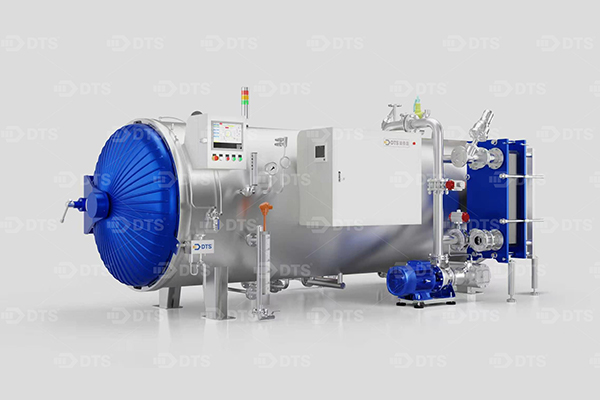
Water Spray Retort
Recirculated spray heating with air overpressure, so pouches, trays and bowls can be processed in one vessel.
View Product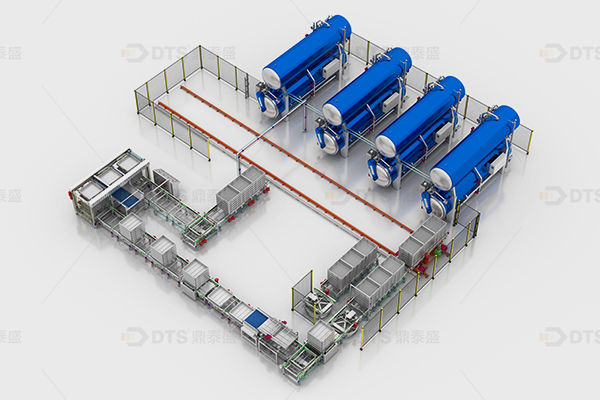
Automated Batch Retort System
Several vessels served by automated loading, with recipe control that keeps the recorded cycle consistent between batches.
View ProductMicrobial Growth Temperature Ranges Compared
The table below sets the three groups side by side on the criteria that matter to a process engineer: the growth band, the optimum, representative organisms, the heat resistance of their spores, and the control lever that follows from each.
| Group and microbial growth temperature | Growth range | Optimum | Representative organisms | Spore heat resistance (D121) | Control lever |
|---|---|---|---|---|---|
| Psychrophiles | Below 0 to about 20 °C | 15 °C or lower | Cold-adapted marine and soil species | Not spore forming in most food-relevant cases | Chilled storage, short shelf life |
| Psychrotrophs | 0 to 7 °C and above | 20 to 30 °C | Listeria monocytogenes, some Bacillus cereus strains | Spores survive chilling and freezing | Cold chain below 4 °C, hygiene, shelf-life limits |
| Mesophiles | 20 to 45 °C | 30 to 37 °C | Clostridium botulinum, Salmonella, Staphylococcus aureus | About 0.21 minutes for C. botulinum | Scheduled process, 12D target, F0 of 3 minutes or more |
| Thermophiles | 45 to 70 °C | 50 to 60 °C | Geobacillus stearothermophilus, Clostridium thermosaccharolyticum | About 1.5 to 4 minutes for G. stearothermophilus | Rapid cooling, storage below 40 °C, ingredient spore load |
Validating a Schedule for a New Product or Pack?
Heat penetration work, a pilot vessel and a production retort that reproduces the same cycle are the three pieces a validation file needs.
Conclusion
Temperature classifies microorganisms, but it does not sterilize them. In the microbial growth temperature model, the psychrophilic and psychrotrophic groups set the requirements for chilling and shelf life, the mesophilic group sets the lethality target for a sealed ambient product, and the thermophilic group sets the cooling and storage rules that a heat process alone cannot replace. Each group is managed by a different lever, and a plant that applies only one of them leaves a gap.
For readers comparing retort equipment manufacturers, DTS publishes process notes covering microbial growth temperature, retort specifications and a direct technical inquiry channel for evaluating a cycle against a specific product and target organism.
FAQ
What is the microbial growth temperature range for foodborne pathogens?
Most foodborne pathogens are mesophiles and grow between about 20 and 45 °C, with an optimum near 30 to 37 °C. Some, such as Listeria monocytogenes, also grow at refrigeration temperature, and spore formers such as Bacillus cereus include strains that grow below 7 °C. The effective range in a specific food shifts with pH, water activity and available nutrients.
Does refrigeration stop bacterial growth?
It slows growth rather than stopping it. Psychrotrophic organisms, including Listeria monocytogenes, continue to multiply at 4 °C, and spores survive chilling and freezing without being damaged. Refrigeration buys shelf life and is essential for chilled products, but it is not a substitute for hygiene, a low initial bioburden or a validated heat process.
Why is Clostridium botulinum the target for a 3 minute F0 process?
Its spores grow and produce toxin in a sealed low-acid pack held at ambient temperature, and its D121 of about 0.21 minutes means a twelve decimal reduction needs about 2.52 minutes at 121.1 °C. Regulators set the minimum at 3 minutes for that reason. Many shelf-stable processes run longer to cover thermophilic spoilage organisms, which are more heat resistant.
Can a retort process eliminate thermophilic spoilage?
Not at a severity a food product can tolerate. With a D121 of roughly 1.5 to 4 minutes for Geobacillus stearothermophilus, a twelve decimal reduction would require 18 to 48 minutes of equivalent time at 121.1 °C. Processes therefore target the pathogens with a validated margin and control thermophilic spoilage by rapid cooling, storage below about 40 °C and limits on the spore load of ingredients.
Why does a change in fill weight require a new process validation?
Fill weight changes the distance heat must travel to the cold spot, and therefore the time at which lethality begins to accumulate there. The same recipe in a larger pack heats more slowly and receives less F0 for the same cycle. Recipe, fill weight, pack dimensions and product characteristics are all part of the scheduled process, so a change to any of them triggers a review.
References and Notes
WHO guidance on safe food handling — bacterial growth ranges, temperature classes and the heat stability of staphylococcal toxin (who.int, accessed 2026-11-13)
FDA guidance on refrigerator temperatures — the 4 °C storage figure used in chilled distribution (fda.gov, accessed 2026-11-13)
Requirements for thermally processed low-acid foods in hermetically sealed containers — scheduled process, records and deviation handling (ecfr.gov, accessed 2026-11-13)
Data notes: the growth ranges and optima in the table are the ranges commonly published for each group, not fixed values for every strain. D121 values of about 0.21 minutes for Clostridium botulinum and about 1.5 to 4 minutes for Geobacillus stearothermophilus are published reference figures; actual resistance varies with the strain, the suspending medium and the recovery conditions. The 3 minute minimum and the 12 decimal reduction convention follow the regulatory and technical literature; they are safety targets, not equipment settings.


