


Why is the heating rate of retorts so important?
In food sterilization processes, many food enterprises only pay attention to two main parameters: sterilization temperature and holding time, yet ignore critical factors including the heating rate of the retort during sterilization.
The heating rate of sterilization retorts has a direct bearing on sterilization speed, thereby affecting energy consumption, overall production efficiency and the final quality of sterilized products.
Heating rate determines the production cycle. The 121°C high-temperature sterilization process serves as a typical example. A slow heating rate of the retort will take far longer for the product load to reach the set temperature, lengthening the total sterilization cycle. Extended heat exposure destroys proteins, vitamins, pigments and other ingredients in food, deteriorating flavor, color and nutritional value, while limiting production output and product quality. In comparison, a fast heating ramp reaches the target processing temperature quickly, lifting production efficiency and facilitating mass production.
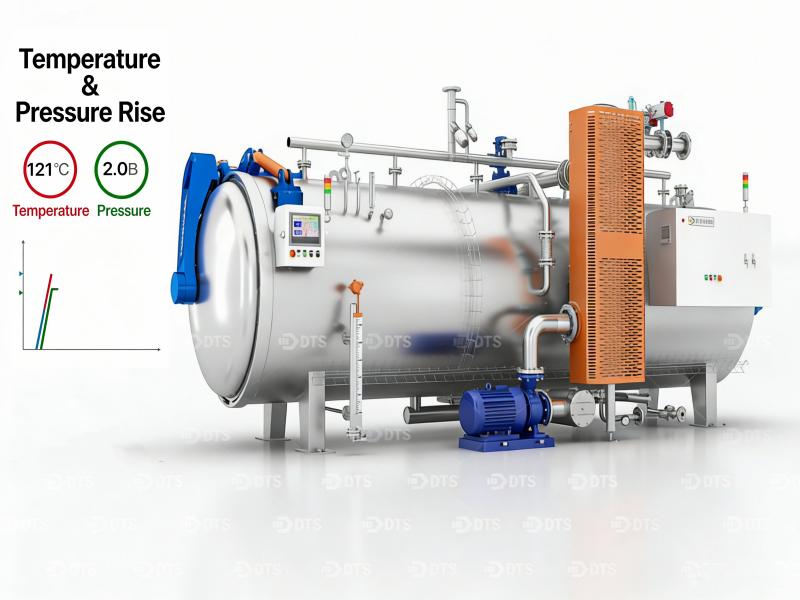
It should be noted that faster heating does not always equal better results. Products packed in glass bottles or plastic packages are prone to deformation and breakage due to huge temperature differences between inside and outside packages when heated too rapidly.
Nowadays, DTS intelligent retorts can automatically adjust heating curves according to different products, striking a balance between intact packaging and effective sterilization. When purchasing retort equipment, apart from temperature specification and tank volume, companies need to attach great importance to heating efficiency, temperature uniformity and automatic control performance. Achieving rapid, even and controllable heating enables manufacturers to secure food safety, maintain stable product quality, cut operating costs and boost overall production capacity.


